
High Dependency Unit at AS Medical Complex
Contact hospital
- Availability
Contact hospital
- Booking
WhatsApp / call
- Location
Islamabad
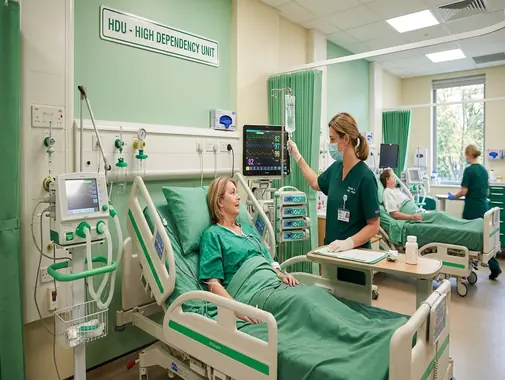
Enhanced Monitoring & Step-Up / Step-Down Hospital Care
The High Dependency Unit – HDU at AS Medical Complex is designed for patients who require a higher level of monitoring, nursing attention, and medical support than can normally be provided in a general inpatient ward, but who do not currently require the full level of organ support associated with an Intensive Care Unit.
The HDU provides an important bridge between:
-
General inpatient wards
-
Emergency care
-
Operating Theatre and postoperative recovery
-
Intensive Care Unit
-
Specialist medical and surgical services
Patients admitted to HDU may be medically unstable, recovering from major surgery, improving after ICU treatment, or at increased risk of deterioration and therefore require closer observation.
WHO recognizes High Dependency Units as part of critical-care systems in which seriously ill patients may require close monitoring, advanced therapies, and rapid intervention if their condition changes.
The purpose of HDU care is to provide the patient with the right level of care at the right stage of illness.
Some patients enter HDU because they need more support than a ward can safely provide.
Others move to HDU from ICU because they have improved but are not yet ready for routine ward-level care.
Our HDU Services
Depending on the patient's clinical condition and the confirmed staffing, equipment, and treatment capabilities of AS Medical Complex, HDU services may include:
-
24-hour enhanced clinical observation
-
Continuous or frequent vital-sign monitoring
-
Heart-rate and rhythm monitoring
-
Blood-pressure monitoring
-
Oxygen-saturation monitoring
-
Respiratory-rate monitoring
-
Temperature monitoring
-
Neurological observation
-
Blood-glucose monitoring
-
Fluid-balance monitoring
-
Urine-output monitoring
-
Oxygen therapy
-
Selected enhanced respiratory support where available
-
Close postoperative monitoring
-
Medical HDU care
-
Surgical HDU care
-
Step-down care following ICU treatment
-
Step-up care from the inpatient ward
-
IV fluid management
-
IV medication
-
Selected blood-pressure support according to unit capability
-
Pain management
-
Blood transfusion support where clinically indicated
-
Laboratory monitoring
-
ECG and cardiac monitoring
-
Portable imaging coordination
-
Nutritional support
-
Wound and drain monitoring
-
Infection surveillance
-
Pressure-injury prevention
-
Mobility and rehabilitation support when clinically appropriate
-
Specialist consultations
-
Emergency escalation to ICU when required
-
Transfer to a general ward after sufficient improvement
-
Referral or transfer to another facility where a required level of care is unavailable
Advanced therapies should only be advertised as routinely available in AS Medical Complex HDU after the exact equipment, staffing, protocols, and clinical capabilities of the unit have been confirmed.
What Is a High Dependency Unit?
A High Dependency Unit provides enhanced hospital care between the general ward and Intensive Care Unit.
Patients in a general ward are usually clinically stable enough to receive routine inpatient monitoring and treatment.
Patients in ICU may require:
-
Invasive mechanical ventilation
-
Advanced cardiovascular support
-
Multiple-organ support
-
Very intensive continuous monitoring
-
Other advanced critical-care interventions
HDU patients generally fall between these two groups.
They may need:
-
More frequent nursing assessment
-
Continuous monitoring
-
Higher oxygen requirements
-
More intensive postoperative observation
-
Closer fluid management
-
More frequent Laboratory testing
-
Rapid access to doctors and specialist care
-
Selected single-organ support depending on the HDU's capabilities
This intermediate role is also how Ali Medical describes its HDU, while established hospital critical-care systems similarly use HDU for patients requiring closer observation or support than a routine ward can safely provide.
HDU should therefore not simply be described as a more comfortable inpatient room.
It is a higher-acuity clinical environment.
Who May Need HDU Admission?
HDU admission depends on the patient's overall condition rather than one diagnosis alone.
Patients may require HDU care because of:
-
Significant postoperative monitoring requirements
-
Respiratory illness requiring closer observation
-
Higher oxygen requirements
-
Severe infection with risk of deterioration
-
Cardiovascular instability that does not currently require full ICU support
-
Acute medical illness requiring enhanced monitoring
-
Significant electrolyte or metabolic abnormalities
-
Selected neurological conditions
-
Acute kidney problems requiring closer observation
-
Major gastrointestinal bleeding after stabilization
-
Trauma after initial stabilization
-
Complicated medical conditions involving several organ systems
-
Recovery after ICU
-
Deterioration on a general ward
-
Other situations where the clinical team believes routine ward monitoring is insufficient
High Dependency Units are commonly used for patients after major surgery, acutely unwell medical patients, and patients stepping down after more intensive critical care.
The treating team decides whether:
-
General ward care is sufficient
-
HDU is appropriate
-
ICU is required
according to the patient's current physiological needs.
HDU Monitoring & Medical Support
One of the main differences between HDU and a standard inpatient ward is the intensity of observation.
A patient who appears stable at one moment may deteriorate over a short period.
Closer monitoring allows the clinical team to identify important changes earlier.
Depending on the patient's condition, monitoring may include:
-
Heart rate
-
Cardiac rhythm
-
Blood pressure
-
Oxygen saturation
-
Respiratory rate
-
Temperature
-
Consciousness
-
Blood glucose
-
Urine output
-
Fluid input and output
-
Pain
-
Other condition-specific observations
WHO emphasizes that patients requiring critical-care services need ongoing assessment because serious illness can change rapidly and may require timely intervention.
Laboratory & Diagnostic Monitoring
HDU patients may require repeated investigations such as:
-
Complete Blood Count
-
Kidney-function tests
-
Electrolytes
-
Liver-function tests
-
Blood glucose
-
Blood gases where clinically indicated
-
Coagulation studies
-
Cardiac biomarkers
-
Infection-related tests
-
Blood cultures
-
Other investigations
The frequency of testing depends on the clinical problem.
Imaging may include:
-
Portable X-Ray
-
Ultrasound
-
Echocardiography
-
CT Scan
-
MRI
-
Other investigations
where clinically indicated.
Patients requiring transport outside HDU should be assessed to determine whether they need monitoring or clinical support during transport.
Respiratory & Cardiovascular Support in HDU
Respiratory and cardiovascular problems are common reasons for enhanced monitoring.
Respiratory Care
Selected HDU patients may require:
-
Supplemental oxygen
-
Continuous oxygen-saturation monitoring
-
Frequent respiratory assessment
-
Chest physiotherapy where appropriate
-
Selected non-invasive respiratory support where available
Some established HDUs provide selected single-organ respiratory support such as non-invasive ventilation, whereas patients requiring invasive mechanical ventilation are generally managed at an ICU level of care.
The exact respiratory treatments available at AS Medical Complex HDU should be confirmed before they are advertised.
A patient whose breathing continues to deteriorate may require ICU transfer for:
-
Airway management
-
Invasive ventilation
-
More advanced respiratory support
Cardiovascular Monitoring
Patients with unstable cardiovascular conditions may require:
-
Continuous ECG monitoring
-
Frequent blood-pressure measurement
-
IV fluids
-
Medication adjustment
-
Electrolyte management
-
Other cardiovascular treatment
depending on their condition.
If a patient develops severe shock, profound cardiovascular instability, or requires advanced circulatory support beyond HDU capability, transfer to ICU may be necessary.
Postoperative & Surgical HDU Care
One of the important roles of HDU is providing enhanced monitoring after major or high-risk surgery.
Not every surgical patient needs intensive care.
However, selected patients may require more observation than a routine surgical ward provides because of:
-
Complexity of surgery
-
Significant blood loss
-
Older age or frailty
-
Heart disease
-
Lung disease
-
Kidney disease
-
Other serious medical conditions
-
Higher postoperative oxygen requirement
-
Risk of bleeding
-
Need for close fluid management
-
Other postoperative concerns
Hospitals commonly use HDU-type care for patients following extensive or higher-risk surgery who require additional nursing, monitoring, and intervention.
Postoperative HDU care may include:
-
Heart-rate and rhythm monitoring
-
Blood-pressure monitoring
-
Oxygen monitoring
-
Pain assessment
-
IV fluids
-
Medication
-
Wound assessment
-
Drain monitoring
-
Urine-output monitoring
-
Blood-count monitoring
-
Observation for bleeding
-
Respiratory assessment
-
Early identification of postoperative complications
As recovery progresses, the patient may be transferred to a routine surgical ward.
If the patient's condition deteriorates, escalation to ICU may be required.
Medical HDU Care
Patients with serious medical illnesses may also require HDU admission.
Examples can include selected patients with:
-
Severe pneumonia
-
Respiratory deterioration
-
Sepsis after initial stabilization
-
Complicated diabetes
-
Significant electrolyte disturbance
-
Acute kidney dysfunction
-
Cardiac conditions
-
Gastrointestinal bleeding
-
Neurological illness
-
Other acute medical problems
The purpose is to provide enhanced observation while treating the underlying disease.
For example, a patient with severe pneumonia may require:
-
Oxygen
-
Antibiotics where appropriate
-
Fluid management
-
Laboratory monitoring
-
Respiratory observation
while the team watches carefully for signs that breathing is improving or deteriorating.
A patient who develops progressive respiratory failure may need escalation from HDU to ICU.
Step-Up & Step-Down Care
The HDU serves two particularly important functions within the hospital.
Step-Up From the Ward
A patient may initially be admitted to a general ward but later become more unwell.
Examples include:
-
Increasing oxygen requirement
-
Falling blood pressure
-
Worsening infection
-
Abnormal heart rhythm
-
Reduced urine output
-
Increasing confusion
-
Significant postoperative concern
If the patient requires more intensive monitoring but does not yet require full ICU treatment, HDU may provide an appropriate step-up level of care.
Step-Down From ICU
A patient may also move from ICU to HDU after significant improvement.
For example, the patient may:
-
No longer require invasive ventilation
-
Have more stable blood pressure
-
Require less organ support
-
Still need closer observation than a general ward
HDU can therefore provide a safer transition between critical illness and routine inpatient care.
SCCM's ICU admission and discharge guidance emphasizes that patients should be managed at a level of care appropriate to their current physiological needs, with movement between levels of care as those needs change.
Sepsis, Infection & Patient Safety
Patients with serious infections may require HDU when their condition needs closer monitoring.
Severe infection can affect:
-
Blood pressure
-
Breathing
-
Kidney function
-
Mental status
-
Other organs
Patients may require:
-
Antibiotics according to clinical indication
-
IV fluids
-
Oxygen
-
Laboratory monitoring
-
Blood cultures
-
Frequent reassessment
-
Treatment of the source of infection
If severe organ dysfunction progresses or shock develops beyond the support available in HDU, ICU transfer may be required.
Infection Prevention
Because HDU patients may have:
-
IV lines
-
Urinary catheters
-
Surgical wounds
-
Oxygen devices
-
Other invasive equipment
infection prevention remains important.
Measures may include:
-
Hand hygiene
-
Appropriate aseptic technique
-
Safe catheter care
-
Safe wound care
-
Equipment cleaning
-
Environmental cleaning
-
Isolation precautions where indicated
-
Appropriate use of antimicrobial medicines
Patient safety also includes prevention of:
-
Medication errors
-
Falls
-
Pressure injuries
-
Unnecessary invasive devices
-
Communication failures during transfer
WHO identifies systematic risk reduction and prevention of avoidable harm as fundamental principles of patient safety.
Pain, Nutrition, Mobility & Recovery
Patients in HDU require more than monitoring.
Recovery also depends on appropriate attention to:
-
Pain
-
Nutrition
-
Mobility
-
Sleep
-
Skin care
-
Emotional wellbeing
Pain Management
Pain may result from:
-
Surgery
-
Trauma
-
Infection
-
Medical procedures
-
Other illness
Pain should be assessed regularly and treated while considering:
-
Breathing
-
Blood pressure
-
Kidney and liver function
-
Level of consciousness
-
Other medication
Excessive sedation can make clinical assessment more difficult, so treatment should be individualized.
Nutrition
Some patients can eat normally.
Others may require:
-
Modified diets
-
Assistance with feeding
-
Tube feeding
-
Other nutritional support
depending on their condition.
Diet & Nutrition services may support the patient's recovery where required.
Mobility & Physiotherapy
Prolonged immobility can cause:
-
Muscle weakness
-
Reduced independence
-
Pressure injuries
-
Deconditioning
When medically safe, recovery may include:
-
Repositioning
-
Bed exercises
-
Sitting
-
Standing
-
Walking
-
Physiotherapy
according to the patient's condition.
Modern critical-care approaches increasingly emphasize appropriate pain control, delirium prevention, mobility, and rehabilitation alongside medical treatment.
HDU vs ICU vs General Ward
Understanding the difference between these areas can help patients and families understand why transfers occur.
General Ward
A general ward is generally suitable when the patient:
-
Is medically stable
-
Requires routine nursing observation
-
Does not require continuous enhanced monitoring
-
Does not require advanced organ support
High Dependency Unit
HDU is generally appropriate when the patient:
-
Requires closer monitoring than a ward
-
Is at increased risk of deterioration
-
Needs enhanced nursing care
-
May require selected single-organ support depending on unit capability
-
Is recovering after major surgery
-
Is stepping down after ICU treatment
Intensive Care Unit
ICU is required when a patient has severe or life-threatening instability requiring the highest level of monitoring or organ support.
This may include:
-
Invasive mechanical ventilation
-
Severe shock requiring advanced support
-
Multiple-organ failure
-
Other complex critical illness
WHO recognizes both ICU and HDU as settings where critical-care services can be provided, while the intensity of treatment is matched to the severity of illness.
The boundaries between HDU and ICU can vary somewhat between hospitals according to:
-
Staffing
-
Equipment
-
Clinical protocols
-
Available specialist services
For this reason, AS Medical Complex should define its HDU capabilities based on its actual operational model.
When Is Transfer to ICU Required?
One of the most important functions of HDU is recognizing when a patient's condition exceeds the safe capability of the unit.
Possible reasons for ICU escalation may include:
-
Severe respiratory failure
-
Need for invasive mechanical ventilation
-
Severe or worsening shock
-
Major cardiovascular instability
-
Significant deterioration in consciousness
-
Multiple-organ dysfunction
-
Persistent severe seizures
-
Major uncontrolled bleeding
-
Severe postoperative deterioration
-
Other life-threatening instability
The decision is made by the treating and critical-care teams.
Transfer should not be delayed simply because the patient was originally admitted to HDU.
Similarly, a patient who improves in ICU may move to HDU as part of a safe step-down pathway.
Family Communication & Visiting HDU
Having a relative admitted to HDU can be stressful because families may understand that the patient is more unwell than someone in a routine ward.
The clinical team should provide appropriate communication regarding:
-
Why HDU care is required
-
Current medical problems
-
Monitoring being performed
-
Important treatments
-
Changes in condition
-
Whether the patient is improving
-
Whether ICU escalation is being considered
-
Expected next steps
Visitor policies may depend on:
-
Patient condition
-
Infection-control requirements
-
Procedures
-
Privacy
-
Current unit policy
Visitors may be asked to:
-
Clean their hands
-
Limit visitor numbers
-
Avoid touching medical equipment
-
Follow staff instructions
-
Use protective equipment where required
Clinical treatment and patient safety must take priority during emergencies and procedures.
Transfer From HDU & Ongoing Recovery
Patients remain in HDU only while they require the enhanced level of monitoring or support.
When the patient's condition improves sufficiently, the clinical team may recommend transfer to:
-
Medical ward
-
Surgical ward
-
Another inpatient department
Transfer may be considered when:
-
Breathing is stable
-
Oxygen requirement has reduced appropriately
-
Blood pressure is stable
-
Heart rhythm is sufficiently stable
-
Level of consciousness is appropriate
-
Organ function is improving
-
Frequent high-dependency interventions are no longer required
The receiving ward should receive an appropriate clinical handover covering:
-
Diagnosis
-
Current condition
-
Recent treatment
-
Medication
-
Oxygen requirements
-
Laboratory results
-
Ongoing concerns
-
Follow-up plan
Some patients continue to require:
-
Physiotherapy
-
Nutritional support
-
Wound care
-
Specialist follow-up
-
Rehabilitation
after leaving HDU.
Improvement sufficient for ward transfer does not necessarily mean complete recovery.
When Should HDU or Critical-Care Assessment Be Considered?
Most patients do not book themselves directly into HDU.
Admission usually follows assessment through:
-
Emergency Department
-
Inpatient ward
-
Operating Theatre
-
Recovery area
-
ICU
-
Another healthcare facility
The treating clinical team determines the appropriate level of care.
A patient with severe symptoms such as:
-
Major breathing difficulty
-
Severe chest pain
-
Shock
-
Loss of consciousness
-
Stroke symptoms
-
Persistent seizure
-
Major trauma
-
Severe bleeding
-
Severe infection with deterioration
-
Other life-threatening symptoms
should receive immediate Emergency assessment.
The Emergency and critical-care teams then determine whether the patient requires:
-
Standard ward care
-
HDU
-
ICU
-
Another specialized service
Multidisciplinary HDU Care
HDU patients often have complex medical and surgical problems, so care may involve several hospital departments.
Depending on the patient's diagnosis, the HDU pathway at AS Medical Complex may involve:
-
Critical Care
-
General Medicine
-
Cardiology
-
Pulmonology
-
Neurology
-
Neurosurgery
-
Nephrology
-
Gastroenterology
-
General & Laparoscopic Surgery
-
Orthopedics
-
Urology
-
Gynecology & Obstetrics
-
Anesthesia
-
Infectious Disease
-
Radiology
-
Laboratory
-
Blood Bank
-
Pharmacy
-
Diet & Nutrition
-
Physiotherapy
-
Other relevant specialties
The purpose of multidisciplinary HDU care is to combine enhanced monitoring with active treatment of the underlying disease, while continually deciding whether the patient:
-
Is improving toward ward-level care
-
Should remain in HDU
-
Requires escalation to ICU
This makes HDU an important part of the hospital's overall critical-care pathway.
HDU FAQs
What is a High Dependency Unit?
A High Dependency Unit – HDU is a specialized hospital area for patients who require more observation, nursing attention, and clinical support than can usually be provided in a general ward, but who may not require the full level of treatment provided in an ICU. Ali Medical describes HDU specifically as an intermediate level between the general ward and ICU.
What is the difference between HDU and ICU?
HDU generally provides enhanced monitoring and selected higher-level support for patients who are more unwell than typical ward patients. ICU provides the highest level of critical care and may include invasive mechanical ventilation, advanced cardiovascular support, or multiple-organ support. Exact HDU and ICU capabilities vary between hospitals.
Why might a patient go to HDU after surgery?
Selected patients require closer monitoring after major or higher-risk surgery because of their medical condition, complexity of the operation, blood loss, oxygen requirement, cardiovascular risks, or other postoperative concerns. HDUs are commonly used for patients requiring enhanced postoperative observation and intervention before they can safely move to a normal surgical ward.
Can a patient move from ICU to HDU?
Yes. HDU frequently provides step-down care when a patient has improved enough to leave ICU but still requires more monitoring or support than a general ward can provide. Patients may later move from HDU to a routine inpatient ward as their condition continues to improve.
Can a patient be transferred from HDU to ICU?
Yes. If a patient develops severe respiratory failure, shock, major cardiovascular instability, significant neurological deterioration, multiple-organ dysfunction, or another problem requiring treatment beyond the capabilities of HDU, escalation to ICU may be required. The decision is based on the patient's physiological condition and required level of organ support.
Does being admitted to HDU mean the patient is on a ventilator?
No. Many HDU patients breathe independently and are admitted primarily for enhanced observation, postoperative monitoring, oxygen therapy, or other higher-level care. Some HDUs can provide selected non-invasive respiratory support, but patients requiring invasive mechanical ventilation are generally cared for in an ICU or equivalent critical-care environment. Exact capabilities depend on the hospital.
How long does a patient stay in HDU?
There is no fixed duration. Some patients require enhanced monitoring only for a short postoperative period, while others with significant medical illness may need longer treatment. A patient can move to a general ward once higher-dependency care is no longer required or be transferred to ICU if the condition deteriorates. The level of care should continually match the patient's current clinical needs.
-
High Dependency Unit at AS Medical Complex
The High Dependency Unit – HDU at AS Medical Complex is designed to provide an intermediate level of hospital care for patients who require closer observation, enhanced nursing, continuous or frequent monitoring, and selected higher-level medical support beyond what is normally available in a general ward.
HDU may support patients who are:
-
Recovering after major surgery
-
Acutely unwell with medical conditions
-
Requiring closer respiratory or cardiovascular monitoring
-
Improving after ICU treatment
-
Deteriorating on a general ward
-
At increased risk of requiring intensive care
The HDU therefore functions as both a step-up and step-down clinical environment.
WHO recognizes HDUs as part of the wider critical-care system, where seriously ill patients can receive close monitoring and appropriate support according to the severity of their condition.
Care at AS Medical Complex may be coordinated with Emergency Services, ICU, General Medicine, Cardiology, Pulmonology, Neurology, Neurosurgery, Nephrology, Gastroenterology, Surgery, Orthopedics, Gynecology, Anesthesia, Infectious Disease, Laboratory, Radiology, Blood Bank, Pharmacy, Physiotherapy, Diet & Nutrition, and other relevant specialties.
The exact respiratory support, cardiovascular medicines, invasive monitoring, dialysis capability, staffing ratios, and other high-dependency interventions available within AS Medical Complex HDU should be described only after the operational capabilities of the unit have been formally confirmed.
For patients who require closer monitoring than a routine ward can safely provide, AS Medical Complex can assess whether High Dependency Unit care, Intensive Care Unit care, or another appropriate inpatient pathway is required. Patients with severe breathing difficulty, shock, loss of consciousness, major bleeding, severe infection with deterioration, or another life-threatening emergency should receive immediate assessment through the Emergency Department.
-