Pulmonary Function Test at AS Medical Complex
Contact hospital
- Availability
Contact hospital
- Booking
WhatsApp / call
- Location
Islamabad
Comprehensive Lung Function & Breathing Assessment
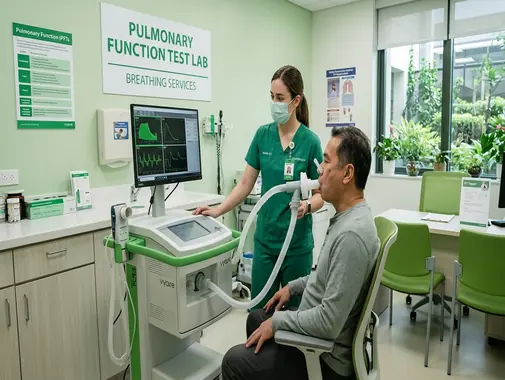
The Pulmonary Function Test – PFT service at AS Medical Complex is designed to assess how effectively the lungs and airways are working and to support the diagnosis, monitoring and management of respiratory conditions.
Pulmonary Function Tests are a group of breathing tests that can measure:
-
How much air the lungs can hold
-
How much air a patient can breathe in and out
-
How quickly air can be expelled from the lungs
-
Whether the airways are narrowed
-
Whether breathing improves after a bronchodilator medicine
-
How efficiently gases move from the lungs into the bloodstream
-
Other aspects of respiratory function
PFT results can help clinicians investigate symptoms such as breathlessness, wheezing and persistent cough, monitor established lung disease, evaluate the effect of treatment and assess respiratory function before selected operations.
At AS Medical Complex, Pulmonary Function Testing can form part of a coordinated respiratory pathway involving Pulmonology, General Medicine, Cardiology, Radiology, Emergency Services and other relevant specialties according to the patient's symptoms and clinical condition.
Our Pulmonary Function Testing Services
Depending on confirmed equipment, trained personnel and clinical requirements, PFT services at AS Medical Complex may include:
-
Spirometry
-
Pre-bronchodilator spirometry
-
Post-bronchodilator spirometry
-
Bronchodilator response assessment
-
Forced Vital Capacity – FVC measurement
-
Forced Expiratory Volume in One Second – FEV1 measurement
-
FEV1/FVC ratio assessment
-
Airflow assessment
-
Lung-volume measurement where available
-
Body plethysmography where available
-
Diffusion-capacity testing – DLCO where available
-
Assessment of obstructive ventilatory patterns
-
Assessment of possible restrictive patterns
-
Monitoring of known respiratory disease
-
Treatment-response monitoring
-
Preoperative respiratory-function assessment
-
Occupational or exposure-related lung-function assessment where clinically appropriate
-
Serial lung-function monitoring
-
Pulmonology consultation and interpretation
-
Referral for additional respiratory investigations where required
Full lung-volume testing, body plethysmography, DLCO, exercise PFTs and other specialized pulmonary-function studies should only be advertised as routinely available after the actual PFT equipment at AS Medical Complex has been confirmed.
What Is a Pulmonary Function Test?
Pulmonary Function Testing describes several non-invasive tests used to objectively evaluate respiratory function.
The most commonly performed PFT is spirometry.
During spirometry, the patient takes a deep breath and then blows into a mouthpiece as forcefully and completely as possible.
The spirometer records measurements including how much air is expelled and how quickly it leaves the lungs. ATS describes spirometry as one of the most commonly ordered lung-function tests, while MedlinePlus identifies it as the most frequently used type of PFT.
Depending on the clinical question, additional PFTs may assess lung volumes or the efficiency with which gases pass from the lungs into the blood.
Therefore, PFT and spirometry are related terms but are not always identical:
-
Spirometry is one type of Pulmonary Function Test.
-
Complete PFTs may include spirometry plus additional lung-volume or diffusion measurements.
Why Is a PFT Performed?
Doctors may request Pulmonary Function Testing when a patient has respiratory symptoms or a condition that could affect the lungs.
Common reasons include:
-
Shortness of breath
-
Wheezing
-
Chronic cough
-
Chest tightness
-
Difficulty taking a deep breath
-
Reduced exercise tolerance
-
Suspected asthma
-
Suspected COPD
-
Known chronic lung disease
-
Suspected pulmonary fibrosis or another interstitial lung disease
-
Abnormal chest imaging
-
Occupational or environmental exposure
-
Monitoring response to respiratory treatment
-
Assessment before selected surgery
Pulmonary-function testing may also be used to monitor conditions outside the lungs that can influence respiratory function.
A PFT is therefore an important diagnostic tool, but its results should be interpreted together with:
-
Medical history
-
Symptoms
-
Physical examination
-
Imaging
-
Laboratory results
-
Other respiratory investigations
A PFT does not replace clinical assessment.
Spirometry & the Main Measurements
Spirometry provides several important measurements.
Forced Vital Capacity – FVC
FVC measures the total amount of air that a person can forcefully breathe out after taking the deepest possible breath.
A reduced FVC can occur for different reasons.
It may be seen with:
-
Restricted lung expansion
-
Severe airflow obstruction with air trapping
-
Poor test technique
-
Neuromuscular weakness
-
Other conditions
For this reason, reduced FVC alone does not automatically prove restrictive lung disease.
True restriction generally requires confirmation with lung-volume measurement when clinically necessary. ERS/ATS interpretation standards use total lung capacity as an important measure when confirming restrictive physiology.
Forced Expiratory Volume in One Second – FEV1
FEV1 measures how much air the patient can forcefully exhale during the first second of the breathing maneuver.
FEV1 can be reduced when airflow is limited.
It is commonly used in the evaluation and monitoring of obstructive respiratory diseases.
FEV1/FVC Ratio
The FEV1/FVC ratio compares how much air leaves the lungs during the first second with the total forced volume expelled.
A reduced ratio can indicate an obstructive ventilatory pattern, although interpretation should use appropriate reference limits and the overall clinical context rather than relying on one isolated number. ERS/ATS standards provide structured strategies for interpreting these measurements.
Obstructive & Restrictive Lung Patterns
One of the important uses of PFT is helping clinicians recognize different physiological patterns of lung dysfunction.
Obstructive Pattern
Obstructive respiratory conditions make it more difficult for air to flow out through narrowed or obstructed airways.
Examples include conditions such as:
-
Asthma
-
COPD
-
Emphysema
-
Other airway diseases
Spirometry is particularly useful for detecting airflow obstruction.
Restrictive Pattern
Restrictive disorders reduce the amount of air the lungs or respiratory system can hold.
Possible causes include:
-
Pulmonary fibrosis
-
Other interstitial lung diseases
-
Chest-wall disorders
-
Neuromuscular conditions
-
Other causes
Spirometry can suggest restriction when lung volumes appear reduced, but complete confirmation may require measurement of total lung capacity.
This distinction is important because similar symptoms such as breathlessness can result from very different respiratory conditions.
Bronchodilator Response Testing
Some patients undergo spirometry both before and after inhaling a bronchodilator medicine.
A bronchodilator helps relax muscles around the airways and can increase airflow.
The process may involve:
-
Performing baseline spirometry.
-
Administering an inhaled bronchodilator according to the testing protocol.
-
Waiting for the appropriate period.
-
Repeating spirometry.
-
Comparing the measurements.
ATS describes post-bronchodilator testing as a way to assess whether airflow improves after an airway-opening medicine.
The results can provide useful information when evaluating airway disease and treatment response.
However, bronchodilator response should be interpreted according to current respiratory standards and the patient's full clinical picture.
A positive or negative response during one PFT does not by itself establish or exclude every respiratory diagnosis.
Lung Volumes & Diffusion Capacity
Some patients require more detailed testing beyond routine spirometry.
Lung-Volume Testing
Lung-volume testing measures quantities of air that standard spirometry cannot fully assess.
It can determine:
-
Total amount of air the lungs can contain
-
Air remaining after maximal exhalation
-
Other lung-volume measurements
One method is body plethysmography, in which the patient sits inside a clear enclosed chamber and breathes through a mouthpiece while pressure changes are measured.
MedlinePlus describes body plethysmography as a particularly accurate way of measuring total lung volume and the amount of air remaining after maximal expiration.
Lung-volume assessment can help distinguish:
-
True restriction
-
Air trapping
-
Hyperinflation
-
Other respiratory patterns
Body plethysmography should only be included in AS Medical Complex's advertised PFT services if the appropriate equipment is available.
Diffusion Capacity – DLCO
A diffusion-capacity test evaluates how effectively gases transfer from the lungs into the bloodstream.
During a typical diffusion test, the patient breathes a very small test concentration of gas, briefly holds their breath and then exhales so the equipment can assess gas transfer. ATS describes diffusion testing as an assessment of how effectively gas passes across the lungs into the blood.
DLCO can provide useful information in selected patients with:
-
Interstitial lung disease
-
Emphysema
-
Pulmonary vascular disease
-
Other respiratory conditions
Interpretation should be combined with spirometry, lung volumes, medical history and other investigations.
PFT for Asthma, COPD & Other Lung Conditions
Pulmonary Function Testing is commonly used in respiratory medicine because many diseases can alter airflow or lung capacity.
Asthma
In suspected asthma, spirometry may identify airflow obstruction and determine whether airflow improves after a bronchodilator.
However, normal spirometry at one point in time does not necessarily exclude asthma because airflow limitation can vary.
The Pulmonologist may therefore interpret the test together with:
-
Symptoms
-
Clinical history
-
Bronchodilator response
-
Other respiratory testing
where required.
COPD
Spirometry is a central objective test when evaluating suspected COPD and can help quantify persistent airflow limitation. MedlinePlus identifies spirometry as a standard lung-function test used in COPD assessment.
Interstitial Lung Disease
Conditions affecting the lung tissue, including pulmonary fibrosis, can produce restrictive physiological changes and reduced gas transfer.
Assessment may require:
-
Spirometry
-
Lung volumes
-
Diffusion testing
-
CT imaging
-
Other clinical investigations
rather than spirometry alone.
PFT Before Surgery & for Occupational Exposure
PFT may sometimes be requested before surgery when the medical team needs more information about the patient's respiratory reserve.
This can be particularly relevant when there is:
-
Known lung disease
-
Significant respiratory symptoms
-
Major thoracic or upper abdominal surgery
-
Other clinical concern regarding respiratory function
PFT can help the surgical and Anesthesia teams understand respiratory status, but it is not automatically necessary before every operation. ATS and MedlinePlus both list evaluation before selected surgical procedures among potential uses of lung-function testing.
Pulmonary-function testing may also be useful when patients have experienced potentially harmful exposure to:
-
Dust
-
Smoke
-
Fumes
-
Chemicals
-
Occupational respiratory hazards
because serial lung-function measurements can sometimes help identify or monitor changes in respiratory function.
How Is Spirometry Performed?
Spirometry is generally painless but requires active patient cooperation.
During a typical test:
-
The patient sits in an appropriate position.
-
A soft nose clip may be applied.
-
The patient places their lips tightly around a mouthpiece connected to the spirometer.
-
The technician asks the patient to take the deepest possible breath.
-
The patient blows out as hard, fast and completely as possible.
-
The maneuver is repeated to obtain technically reliable measurements.
ATS notes that spirometry generally requires multiple attempts to obtain an acceptable and reproducible result, and standardized spirometry guidance has long emphasized obtaining multiple acceptable forced expiratory maneuvers.
Proper coaching is important.
The technician may repeatedly encourage the patient to:
-
Take a full breath
-
Seal the lips tightly
-
Blow immediately
-
Continue exhaling until instructed to stop
This is necessary because spirometry quality depends significantly on correct technique and patient effort.
A technically poor test can produce misleading results.
Preparing for a Pulmonary Function Test
Following preparation instructions helps improve the accuracy and safety of the test.
ATS recommends several practical precautions before PFT, including avoiding smoking shortly before testing, avoiding heavy exercise immediately beforehand, not eating a large meal within two hours, wearing clothing that does not restrict breathing, and asking whether respiratory medicines should be withheld before the test.
Patients should therefore follow the specific instructions provided by AS Medical Complex.
Preparation may include:
-
Wear loose, comfortable clothing.
-
Avoid a large meal shortly before testing.
-
Avoid heavy exercise before the test.
-
Follow instructions regarding smoking.
-
Follow instructions regarding caffeine or alcohol if relevant to the planned test.
-
Bring your inhalers or medication list when requested.
-
Tell staff which respiratory medicines you use.
Do Not Stop Inhalers Without Instructions
Some PFTs are intended to assess lung function without the effect of a bronchodilator, so the clinician may ask a patient to withhold selected inhaled medicines for a specific period.
Other tests may need the patient to continue treatment as usual.
Therefore:
Do not stop your inhaler or other prescribed respiratory medicine simply because you are having a PFT unless the healthcare team specifically tells you to do so.
Safety, Precautions & When Testing May Be Delayed
Pulmonary Function Tests are generally low-risk.
Because spirometry involves deep inhalation and forceful exhalation, some patients may temporarily experience:
-
Light-headedness
-
Dizziness
-
Cough
-
Fatigue
-
Breathlessness
MedlinePlus and ATS describe these as possible temporary effects of forceful breathing maneuvers.
Patients should immediately tell the technician if they feel significantly unwell.
The healthcare team should also be informed before testing if the patient has recently experienced or undergone:
-
Heart attack
-
Significant cardiovascular instability
-
Eye surgery
-
Sinus or ear surgery
-
Chest surgery
-
Abdominal surgery
-
Another condition in which forceful breathing could be unsafe
ATS advises patients to report recent heart attack or recent eye, sinus, ear, chest or abdominal surgery before PFT because testing may need to be delayed or modified.
Patients should also tell staff if they currently have a significant cold, flu or acute respiratory infection because illness can affect both the safety and accuracy of testing.
If body plethysmography is planned, patients with significant claustrophobia should tell staff in advance because the test involves sitting inside a clear enclosed chamber.
Understanding PFT Results
Pulmonary Function Test results are compared with appropriate reference values based on characteristics such as:
-
Age
-
Height
-
Sex
-
Relevant reference equations
ATS and ERS maintain technical standards for interpreting routine lung-function testing, and current interpretation increasingly emphasizes appropriate reference ranges and lower limits of normal rather than simply treating one fixed percentage as normal for every patient.
Important measurements may include:
-
FEV1
-
FVC
-
FEV1/FVC
-
Lung volumes where performed
-
Diffusion capacity where performed
-
Bronchodilator response where performed
The report may describe findings as:
-
Within expected limits
-
Obstructive pattern
-
Possible restrictive pattern
-
Confirmed restriction when appropriate lung-volume testing is available
-
Mixed physiological pattern
-
Reduced diffusion capacity
-
Other abnormality
depending on the tests performed.
PFT interpretation should not be used as a diagnosis in isolation.
For example, an obstructive pattern may be compatible with more than one airway disease.
Similarly, reduced FVC on spirometry does not by itself confirm pulmonary fibrosis or another restrictive lung disease.
The final diagnosis may require correlation with:
-
Symptoms
-
Physical examination
-
Chest X-Ray
-
CT Scan
-
Laboratory testing
-
Allergy or other respiratory testing
-
Cardiac evaluation
-
Other investigations
When Should You Consider a PFT?
Pulmonary Function Testing may be appropriate when you have:
-
Persistent shortness of breath
-
Recurrent wheezing
-
Chronic cough
-
Unexplained chest tightness
-
Reduced exercise tolerance
-
Suspected asthma
-
Suspected COPD
-
Known chronic respiratory disease requiring monitoring
-
Abnormal lung imaging
-
Suspected occupational lung exposure
-
Suspected restrictive lung disease
-
Need for respiratory assessment before selected surgery
-
Treatment requiring monitoring of pulmonary function
PFT may also be repeated over time to determine whether lung function is:
-
Stable
-
Improving
-
Declining
-
Responding to treatment
ATS notes that serial lung-function testing can help detect changes in chronic disease and may indicate when treatment requires reassessment.
When Is Emergency Care Required Instead of a Routine PFT?
Pulmonary Function Testing is primarily an outpatient diagnostic investigation.
It is not an emergency treatment for acute respiratory distress.
Seek immediate Emergency assessment rather than waiting for a routine PFT appointment if a patient develops:
-
Severe or rapidly worsening breathing difficulty
-
Blue or grey lips or skin
-
Severe chest pain
-
Loss of consciousness
-
Severe confusion
-
Inability to speak because of breathlessness
-
Sudden severe wheezing with respiratory distress
-
Coughing up a significant amount of blood
-
Other major respiratory deterioration
These symptoms may represent respiratory failure, severe asthma, pulmonary embolism, cardiac disease or another acute medical emergency requiring immediate clinical assessment. MedlinePlus describes respiratory failure as a serious condition in which blood oxygen may become dangerously low or carbon dioxide dangerously high and requires urgent medical evaluation.
A PFT can be performed later if clinically appropriate once the acute condition has been stabilized.
Multidisciplinary Respiratory Assessment & Follow-Up
Pulmonary Function Test results are most useful when integrated into the patient's wider clinical evaluation.
Depending on the findings, care at AS Medical Complex may involve:
-
Pulmonology
-
General Medicine
-
Cardiology
-
Radiology
-
Pediatrics where appropriate
-
Rheumatology for selected systemic diseases
-
Physiotherapy
-
Anesthesia for preoperative assessment
-
Emergency Department
-
ICU or HDU for acute severe respiratory disease
-
Other specialties
Further investigations may include:
-
Chest X-Ray
-
CT Chest
-
Oxygen-saturation measurement
-
Arterial Blood Gas testing
-
Laboratory investigations
-
Echocardiography
-
Other respiratory testing
according to the patient's symptoms and PFT results.
MedlinePlus notes that PFT findings are frequently interpreted alongside other tests, and additional oxygen or blood-gas assessment may be required in selected patients.
The aim is not simply to generate numbers.
The aim is to understand why the patient has respiratory symptoms, how significantly lung function is affected, whether treatment is working and what further evaluation is required.
Pulmonary Function Test FAQs
What is a Pulmonary Function Test?
A Pulmonary Function Test – PFT is a group of breathing tests used to assess how well the lungs and airways function. Tests can measure airflow, the volume of air the lungs can hold and, with specialized testing, how effectively gases transfer from the lungs into the bloodstream. Spirometry is the most commonly performed PFT.
What is the difference between spirometry and a full PFT?
Spirometry measures how much air you can forcefully exhale and how quickly you can exhale it. A more complete PFT may additionally include lung-volume testing and diffusion-capacity testing. The exact combination depends on the clinical question and available equipment.
Can PFT diagnose asthma or COPD?
PFT can provide important objective evidence of airflow obstruction and can assess changes after bronchodilator medication. It is commonly used during evaluation of asthma and COPD. However, the final diagnosis should combine PFT findings with symptoms, history, examination and other investigations rather than relying on one measurement alone.
Does a PFT hurt?
PFT is generally painless and non-invasive, although forceful breathing requires effort. Some patients temporarily feel tired, light-headed, dizzy, breathless or develop a cough during testing. Tell the technician immediately if you feel significantly unwell.
Should I stop my inhaler before a PFT?
Only if specifically instructed. Some tests require selected bronchodilator medicines to be withheld for a defined period, while other tests may be performed while treatment is continued. Never stop prescribed inhalers or other medicines independently. Ask the PFT team or referring doctor for instructions before the appointment.
Can spirometry tell whether I have restrictive lung disease?
Spirometry can suggest a restrictive pattern if volumes such as FVC are reduced, but reduced FVC does not automatically prove true restriction. When clinically necessary, lung-volume testing—particularly measurement of total lung capacity—is used to confirm restrictive physiology.
How should I prepare for my Pulmonary Function Test?
Follow the instructions provided by the testing team. In general, ATS advises avoiding a large meal within two hours, avoiding heavy exercise shortly beforehand, avoiding smoking before testing, wearing clothing that allows unrestricted breathing, and checking whether any inhaled medicines need to be withheld. Tell the team if you are acutely unwell or have recently had significant surgery or a heart attack.
Pulmonary Function Test at AS Medical Complex
The Pulmonary Function Test – PFT service at AS Medical Complex is designed to provide objective assessment of breathing and lung function for patients with respiratory symptoms, established lung disease, suspected airflow limitation, occupational exposure or selected preoperative requirements.
Depending on confirmed equipment and clinical need, PFT assessment may include:
-
Spirometry
-
FEV1 and FVC measurement
-
FEV1/FVC assessment
-
Bronchodilator response testing
-
Lung-volume testing where available
-
Diffusion-capacity testing where available
-
Serial respiratory-function monitoring
ATS and ERS standards emphasize that accurate lung-function testing requires proper test technique, quality-controlled measurements and appropriate interpretation using validated reference standards.
PFT results may help distinguish an obstructive respiratory pattern from possible restrictive physiology, assess response to bronchodilator therapy and monitor changes in lung function over time. However, the numbers should always be interpreted in the context of the patient's symptoms, medical history and other investigations.
At AS Medical Complex, PFT can be coordinated with Pulmonology, General Medicine, Cardiology, Radiology, Anesthesia, Emergency Services and other appropriate departments according to the patient's condition.
Contact AS Medical Complex for Pulmonary Function Testing if you have persistent breathlessness, wheezing, chronic cough, suspected asthma or COPD, an established respiratory condition requiring monitoring, or have been advised to undergo lung-function assessment. Patients with severe or rapidly worsening breathing difficulty should seek immediate Emergency medical assessment rather than waiting for a routine PFT appointment.