Speech and Language Pathology at AS Medical Complex
Contact hospital
- Availability
Contact hospital
- Booking
WhatsApp / call
- Location
Islamabad
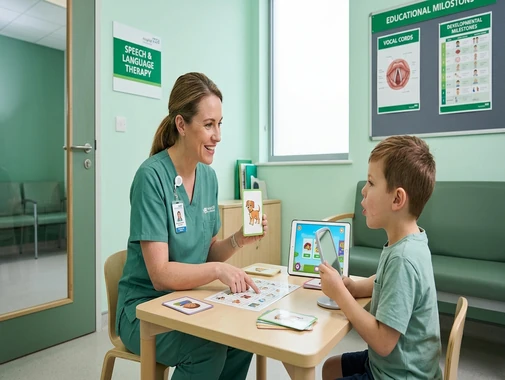
Comprehensive Speech, Language, Communication & Swallowing Care
The Speech and Language Pathology Department at AS Medical Complex provides comprehensive assessment, therapy, rehabilitation, and ongoing support for children and adults experiencing difficulties with speech, language, communication, voice, fluency, cognition, feeding, or swallowing.
Speech-language pathologists assess and treat a broad range of communication and swallowing disorders affecting people of all ages. These may involve difficulties producing speech sounds, understanding or expressing language, speaking fluently, using the voice effectively, communicating after neurological illness, or swallowing food and liquids safely.
Our approach is individualized according to each patient's age, diagnosis, abilities, medical history, communication needs, and rehabilitation goals.
Our Speech and Language Pathology Services
The Speech and Language Pathology Department at AS Medical Complex may provide assessment and therapy for:
-
Speech delay
-
Language delay
-
Speech sound disorders
-
Articulation difficulties
-
Phonological disorders
-
Childhood Apraxia of Speech
-
Adult apraxia of speech
-
Stuttering
-
Cluttering
-
Fluency disorders
-
Voice disorders
-
Hoarse or weak voice
-
Language comprehension difficulties
-
Expressive language difficulties
-
Social communication difficulties
-
Aphasia
-
Dysarthria
-
Cognitive-communication disorders
-
Communication difficulties after stroke
-
Communication difficulties after brain injury
-
Communication problems associated with neurological disorders
-
Feeding difficulties in children
-
Swallowing disorders
-
Dysphagia
-
Communication rehabilitation after surgery
-
Communication support following head and neck conditions
-
Alternative and Augmentative Communication (AAC)
-
Pediatric speech and language therapy
-
Adult speech and language rehabilitation
-
Family and caregiver education
-
Home communication strategies
-
Long-term speech and language rehabilitation
The services recommended depend on the patient's assessment and individual clinical needs.
Speech Sound Disorders
Speech sound disorders can make it difficult for a child or adult to produce certain sounds clearly.
Children normally make some speech errors while learning to talk. However, persistent difficulties as a child gets older may require professional assessment. Children with speech sound disorders may substitute sounds, leave sounds out, add sounds, or have difficulty producing particular sounds accurately.
Possible signs may include:
-
Speech that is difficult to understand
-
Replacing one sound with another
-
Leaving sounds out of words
-
Adding unnecessary sounds
-
Difficulty producing certain speech sounds
-
Persistent pronunciation difficulties
-
Frustration when others cannot understand speech
-
Avoidance of speaking because of speech difficulties
A speech-language pathologist can evaluate the pattern of errors and determine whether therapy is appropriate.
Articulation Therapy
Articulation refers to how speech sounds are produced using the lips, tongue, jaw, palate, and other structures involved in speech.
Articulation therapy may help patients who:
-
Have difficulty producing particular sounds
-
Pronounce certain words incorrectly
-
Have unclear speech
-
Are frequently misunderstood
-
Have persistent sound-production errors
-
Have speech changes following neurological disease or injury
Therapy may involve structured practice of individual sounds, words, sentences, conversation, and techniques for improving speech clarity.
Language Delay
Language involves understanding and using words, sentences, and other forms of communication.
A child with a language delay may have difficulty:
-
Learning new words
-
Combining words into sentences
-
Expressing wants and needs
-
Understanding instructions
-
Answering questions
-
Following conversations
-
Telling stories
-
Using age-appropriate vocabulary
-
Communicating with family or peers
Language problems may involve receptive language, meaning difficulty understanding language, expressive language, meaning difficulty communicating thoughts and ideas, or both.
Speech-language pathologists assess language development and can recommend therapy based on the child's individual strengths and difficulties.
Early Speech & Language Development
Children develop communication skills gradually, and there is natural variation in development.
However, parents may consider a speech and language assessment if a child:
-
Is not developing speech as expected
-
Has very limited vocabulary
-
Has difficulty combining words
-
Is difficult to understand
-
Does not appear to understand simple instructions
-
Has difficulty communicating needs
-
Becomes frustrated when trying to communicate
-
Appears to lose previously acquired communication skills
-
Has feeding or swallowing concerns alongside communication difficulties
ASHA recommends professional assessment when parents have concerns about a child's speech, language, or feeding development.
Early assessment can help determine whether development is within the expected range or whether additional support may be beneficial.
Childhood Apraxia of Speech
Childhood Apraxia of Speech (CAS) is a motor speech disorder in which a child knows what they want to say but has difficulty planning and coordinating the movements required for clear speech.
Possible features may include:
-
Limited speech
-
Difficulty producing sounds consistently
-
Words sounding different each time they are attempted
-
Difficulty moving smoothly between sounds
-
Greater difficulty with longer words
-
Speech that is difficult to understand
-
Visible effort when attempting to speak
Diagnosis requires specialized speech-language assessment.
Therapy is individualized and may require repeated practice of speech movements and sounds.
Stuttering & Fluency Disorders
Stuttering affects the flow or fluency of speech.
A person may:
-
Repeat sounds
-
Repeat syllables
-
Repeat words
-
Stretch sounds
-
Experience blocks where speech temporarily stops
-
Show physical tension while speaking
-
Avoid certain words
-
Avoid speaking situations
-
Experience anxiety related to communication
Stuttering commonly begins during childhood, although it can continue into adulthood.
Speech-language therapy may focus on:
-
Improving communication confidence
-
Reducing physical struggle during speech
-
Developing fluency-management strategies
-
Managing avoidance behaviors
-
Supporting participation in school, work, and social situations
The goal of therapy is individualized and should not simply be defined as making every person speak without any disfluency.
Voice Disorders
A voice disorder may affect:
-
Voice quality
-
Pitch
-
Loudness
-
Vocal endurance
-
Resonance
Patients may experience:
-
Persistent hoarseness
-
Weak voice
-
Breathy voice
-
Strained voice
-
Rough voice
-
Voice fatigue
-
Loss of voice
-
Difficulty speaking loudly enough
-
Changes in pitch
Speech-language pathologists work with voice problems involving pitch, volume, and voice quality.
Voice problems may result from vocal misuse, structural abnormalities, neurological conditions, surgery, inflammation, or other causes.
Persistent voice changes may require coordinated assessment with ENT so that the vocal cords and larynx can be medically examined before or alongside voice therapy.
Voice Therapy
Depending on the diagnosis, voice therapy may focus on:
-
Reducing excessive vocal strain
-
Improving breath support
-
Improving vocal efficiency
-
Developing healthier voice-production techniques
-
Improving loudness
-
Improving voice endurance
-
Reducing harmful vocal behaviors
-
Supporting recovery after selected voice conditions or procedures
The therapy plan depends on the underlying cause of the voice problem.
Dysarthria
Dysarthria is a motor speech disorder caused by problems affecting the muscles or neurological control required for speech. It can make speech difficult for other people to understand.
Patients may experience:
-
Slurred speech
-
Slow speech
-
Weak voice
-
Reduced speech volume
-
Unclear pronunciation
-
Changes in rhythm
-
Difficulty coordinating breathing and speaking
-
Reduced facial or oral movement
Dysarthria can occur after or alongside conditions such as:
-
Stroke
-
Brain injury
-
Parkinson's disease
-
Multiple sclerosis
-
Other neurological disorders
Therapy may focus on improving speech clarity, breathing, voice, articulation, communication strategies, or alternative communication methods depending on severity.
Apraxia of Speech in Adults
Apraxia of speech is a motor-planning disorder in which the brain has difficulty coordinating the movements required for speech even though the person knows what they want to say.
It may occur following:
-
Stroke
-
Brain injury
-
Neurological disease
-
Other brain conditions
Symptoms may include:
-
Difficulty initiating words
-
Inconsistent sound errors
-
Slow or effortful speech
-
Difficulty sequencing sounds
-
Greater difficulty with longer words or sentences
Speech-language therapy may involve repeated structured practice aimed at rebuilding speech-planning skills.
Aphasia
Aphasia is a language disorder caused by damage to areas of the brain involved in language. It can affect speaking, understanding language, reading, writing, or several of these abilities together.
Aphasia commonly occurs following:
-
Stroke
-
Brain injury
-
Brain surgery
-
Neurological disease
-
Other conditions affecting language areas of the brain
A person with aphasia may:
-
Know what they want to say but struggle to find words
-
Use the wrong words
-
Have difficulty constructing sentences
-
Have difficulty understanding conversation
-
Struggle with reading
-
Struggle with writing
-
Become frustrated during communication
Aphasia does not automatically mean that the person's intelligence has been lost.
Speech & Language Therapy After Stroke
Stroke can affect several communication and swallowing functions.
Following a stroke, patients may develop:
-
Aphasia
-
Dysarthria
-
Apraxia of speech
-
Cognitive-communication problems
-
Voice changes
-
Swallowing difficulties
Speech-language rehabilitation may focus on:
-
Word finding
-
Understanding speech
-
Forming sentences
-
Reading and writing
-
Speech clarity
-
Communication strategies
-
Cognitive communication
-
Swallowing
-
Family and caregiver communication training
Care may be coordinated with:
-
Neurology
-
Physiotherapy
-
Occupational rehabilitation
-
Diet & Nutrition
-
Psychology
-
Other rehabilitation services
Cognitive-Communication Disorders
Communication depends not only on speech and language but also on cognitive abilities such as attention, memory, organization, reasoning, and executive function.
Cognitive-communication difficulties may occur after:
-
Stroke
-
Traumatic brain injury
-
Neurological disease
-
Brain surgery
-
Other conditions affecting cognition
Patients may experience difficulty with:
-
Maintaining attention
-
Remembering information
-
Organizing thoughts
-
Following conversations
-
Solving problems
-
Understanding complex information
-
Planning what to say
-
Staying on topic
-
Social communication
Traumatic brain injury, for example, can result in problems involving speech, language, and communication.
Therapy may focus on practical strategies that help the person communicate more effectively in everyday situations.
Social Communication
Social communication involves understanding how language and nonverbal communication are used in different social situations.
Difficulties may include:
-
Taking turns during conversation
-
Staying on topic
-
Understanding jokes or implied meanings
-
Interpreting facial expression or body language
-
Adjusting communication to different listeners
-
Starting or ending conversations appropriately
Speech-language pathologists may assess social communication and develop therapy based on the person's individual communication needs.
Feeding Difficulties in Children
Speech-language pathologists can also work with children who have feeding and swallowing difficulties.
Signs that may warrant assessment include:
-
Difficulty chewing
-
Coughing during meals
-
Choking during eating or drinking
-
Very prolonged mealtimes
-
Difficulty managing different food textures
-
Food or liquid leaking from the mouth
-
Difficulty coordinating sucking, swallowing, and breathing
-
Repeated respiratory symptoms associated with feeding
-
Significant difficulty progressing to age-appropriate textures
Assessment should consider the child's medical, developmental, nutritional, and feeding history.
Care may involve coordination with Pediatrics, Diet & Nutrition, Gastroenterology, ENT, and other specialists where appropriate.
Swallowing Disorders – Dysphagia
Dysphagia is the medical term for difficulty swallowing.
Speech-language pathologists play an important role in evaluating and managing swallowing disorders.
Swallowing problems may occur because of:
-
Stroke
-
Neurological disease
-
Brain injury
-
Head and neck conditions
-
Surgery
-
Cancer treatment
-
Muscle weakness
-
Aging-related medical conditions
-
Other disorders affecting swallowing
Signs of a Swallowing Problem
Possible signs of dysphagia include:
-
Coughing while eating or drinking
-
Coughing immediately after swallowing
-
Frequent throat clearing during meals
-
Wet or gurgling voice after swallowing
-
Food feeling stuck in the throat
-
Difficulty chewing
-
Food remaining inside the mouth
-
Liquid leaking from the mouth
-
Taking an unusually long time to eat
-
Difficulty swallowing tablets
-
Recurrent chest infections associated with swallowing problems
These are recognized warning signs of swallowing difficulty.
Patients experiencing swallowing problems should receive appropriate professional assessment because treatment depends on the underlying cause and type of swallowing impairment.
Swallowing Assessment
A swallowing assessment may include evaluation of:
-
Medical history
-
Neurological condition
-
Oral movements
-
Tongue and lip function
-
Voice
-
Cough strength
-
Ability to manage saliva
-
Eating and drinking
-
Different food and liquid consistencies
-
Signs suggesting airway compromise
Where appropriate, further instrumental swallowing assessment may be recommended or coordinated with the relevant medical and radiology services.
The specific evaluation used depends on the patient's condition and available services.
Swallowing Rehabilitation
Following assessment, therapy may include:
-
Swallowing exercises
-
Postural strategies
-
Safe-swallowing techniques
-
Modification of bite or sip size
-
Pacing strategies
-
Oral-motor rehabilitation where appropriate
-
Patient and caregiver education
-
Recommendations regarding food or liquid consistency when clinically indicated
-
Coordination with Diet & Nutrition
Diet consistency should not be modified unnecessarily without appropriate clinical assessment because nutritional and hydration requirements must also be considered.
Communication After Brain Injury
Traumatic or acquired brain injury can affect:
-
Speech
-
Language
-
Attention
-
Memory
-
Organization
-
Social communication
-
Problem-solving
-
Swallowing
Speech and language difficulties after traumatic brain injury may include dysarthria, apraxia, aphasia, and broader communication problems.
Rehabilitation is tailored to the patient's specific neurological and functional difficulties.
Speech Therapy for Neurological Conditions
Speech-language therapy may be useful for selected patients with neurological conditions such as:
-
Stroke
-
Parkinson's disease
-
Multiple sclerosis
-
Traumatic brain injury
-
Motor-neuron and neuromuscular disorders
-
Other neurological conditions affecting communication or swallowing
Depending on the condition, therapy may focus on:
-
Speech clarity
-
Voice volume
-
Language
-
Cognitive communication
-
Swallowing
-
Alternative communication
-
Caregiver training
Care can be coordinated with the Neurology Department.
Parkinson's Disease & Communication
Parkinson's disease can affect speech and voice.
Some patients may experience:
-
Reduced voice volume
-
Monotone speech
-
Rapid speech
-
Reduced articulation
-
Difficulty being understood
-
Changes in facial expression
-
Swallowing difficulties
Speech-language therapy may help patients develop strategies to improve communication and maintain functional speech.
Swallowing should also be assessed when relevant symptoms develop.
Alternative & Augmentative Communication – AAC
Some patients cannot communicate effectively using speech alone.
Augmentative and Alternative Communication (AAC) refers to methods that supplement or replace spoken communication.
The Ali Medical reference department specifically includes AAC within its Speech and Language Pathology services.
AAC may involve:
-
Communication boards
-
Picture-based systems
-
Written communication
-
Gesture
-
Alphabet boards
-
Communication books
-
Tablet-based communication
-
Speech-generating devices
-
Other communication technologies
AAC may be considered for children or adults with severe communication difficulties.
The purpose is to help the person communicate needs, choices, ideas, emotions, and information as independently as possible.
Pediatric Speech Therapy
Children may require speech-language therapy for:
-
Delayed speech
-
Delayed language
-
Unclear speech
-
Speech sound disorders
-
Stuttering
-
Childhood apraxia
-
Social communication difficulties
-
Feeding problems
-
Swallowing problems
-
Other developmental communication concerns
Therapy should be age-appropriate and may involve games, structured activities, conversation, visual materials, play, and family participation.
Parents and caregivers often play an important role in helping children practice communication skills outside therapy sessions.
Adult Speech Therapy
Adults may require speech-language therapy following:
-
Stroke
-
Brain injury
-
Neurological disease
-
Surgery
-
Head and neck conditions
-
Voice problems
-
Swallowing disorders
-
Other acquired communication difficulties
The Ali Medical reference page likewise notes that adults can benefit from speech-language treatment for articulation, voice, language, cognitive communication, and swallowing problems.
Adult rehabilitation focuses on meaningful everyday communication and functional independence.
Family & Caregiver Education
Communication and swallowing difficulties often affect the whole family.
Speech-language pathologists may provide guidance to family members and caregivers regarding:
-
How to communicate more effectively with the patient
-
Giving the person enough time to respond
-
Simplifying communication when appropriate
-
Using visual or written supports
-
Supporting therapy exercises
-
Safe-feeding recommendations
-
Use of AAC systems
-
Recognizing changes requiring reassessment
Family participation can help therapy strategies carry over into everyday life.
Speech & Language Assessment
A comprehensive assessment may involve:
-
Medical and developmental history
-
Hearing history
-
Speech-sound assessment
-
Language comprehension
-
Expressive language
-
Fluency
-
Voice
-
Oral-motor examination
-
Cognitive-communication assessment
-
Social communication
-
Feeding or swallowing assessment when relevant
-
Functional communication
-
Family or caregiver concerns
Standardized and non-standardized tools may be used according to age, condition, language, and clinical requirements.
Hearing & Speech Development
Hearing plays an important role in speech and language development.
A child who does not hear speech clearly may have difficulty developing speech sounds and language.
When hearing problems are suspected, the speech-language pathologist may recommend assessment by Audiology or ENT.
Children with cochlear implants or hearing devices may also require communication rehabilitation depending on their individual needs.
Speech Therapy After Cochlear Implant
Some patients receiving cochlear implants require structured auditory and communication rehabilitation.
Depending on age and hearing history, support may focus on:
-
Listening skills
-
Speech recognition
-
Speech production
-
Language development
-
Communication strategies
-
Family training
Care can be coordinated between Speech and Language Pathology, ENT, Audiology, Pediatrics, and other relevant specialists.
Multidisciplinary Rehabilitation
Communication and swallowing problems may be part of a broader medical or developmental condition.
Depending on the patient's needs, Speech and Language Pathology may coordinate with:
-
Pediatrics
-
Neurology
-
ENT
-
Psychology
-
Psychiatry
-
Physiotherapy
-
Diet & Nutrition
-
Gastroenterology
-
Radiology
-
Neurosurgery
-
Oncology
-
Other relevant medical specialties
This multidisciplinary approach can be particularly important for patients recovering from stroke, neurological disease, brain injury, surgery, or complex developmental conditions.
When Should You Take Your Child to a Speech-Language Pathologist?
Parents may consider a professional assessment when a child:
-
Is not developing speech or language as expected
-
Has very limited vocabulary
-
Is consistently difficult to understand
-
Has persistent difficulty producing speech sounds
-
Struggles to understand instructions
-
Cannot communicate wants and needs effectively
-
Stutters frequently or appears distressed by stuttering
-
Has difficulty interacting socially through communication
-
Has feeding or swallowing difficulties
-
Has experienced regression in speech or language
-
Has hearing loss affecting communication
-
Has a neurological or developmental condition affecting communication
The Ali Medical reference page similarly recommends speech therapy assessment for children with difficulties involving speech production, language development, understanding directions, social communication, feeding, or swallowing.
When Should an Adult See a Speech-Language Pathologist?
Adults may benefit from assessment if they experience:
-
Speech changes after stroke
-
Difficulty finding words
-
Difficulty understanding language
-
Slurred speech
-
Reduced voice volume
-
Persistent voice changes
-
Stuttering
-
Communication problems after brain injury
-
Cognitive-communication difficulties
-
Difficulty swallowing
-
Coughing during meals
-
Communication difficulties related to neurological disease
-
Loss of previously normal speech or language abilities
Sudden new speech or language difficulty—particularly with facial weakness, arm weakness, confusion, or loss of balance—may represent a stroke and requires immediate emergency medical assessment, not a routine speech-therapy appointment.
How Long Does Speech Therapy Take?
There is no fixed duration of speech-language therapy.
The Ali Medical reference page notes that treatment duration varies according to the individual's needs, severity of the disorder, and therapy goals.
Factors affecting the duration of treatment may include:
-
Diagnosis
-
Severity
-
Age
-
Cause of the problem
-
Duration of the condition
-
Frequency of therapy
-
Medical conditions
-
Participation in therapy
-
Home practice
-
Family involvement
-
Individual rehabilitation goals
Some patients may require short-term therapy, while others with developmental or neurological conditions may need longer-term rehabilitation.
Individualized Therapy Plans
Following assessment, the speech-language pathologist develops goals based on the patient's specific needs.
Goals may include:
-
Improving speech clarity
-
Developing vocabulary
-
Improving sentence formation
-
Improving understanding of language
-
Increasing communication confidence
-
Improving fluency
-
Improving voice quality
-
Supporting communication after stroke
-
Improving cognitive communication
-
Improving swallowing safety
-
Developing AAC use
-
Improving participation in school, work, family, or social activities
Progress should be reviewed regularly, and goals can be modified as the patient's abilities change.
Speech and Language Pathology FAQs
What is Speech and Language Pathology?
Speech and Language Pathology is a healthcare field focused on assessing and treating disorders involving speech, language, communication, voice, fluency, cognition, feeding, and swallowing.
What conditions does a speech-language pathologist treat?
Speech-language pathologists work with conditions including speech sound disorders, language difficulties, stuttering, voice disorders, aphasia, dysarthria, cognitive-communication disorders, swallowing problems, and other communication difficulties in children and adults.
When should I seek speech therapy for my child?
Assessment may be appropriate if your child has difficulty developing speech or language, is difficult to understand, struggles to understand or express language, stutters, has social-communication problems, or experiences feeding or swallowing difficulties.
Can adults benefit from speech therapy?
Yes. Adults may need speech-language therapy after stroke, brain injury, neurological disease, surgery, or other medical conditions affecting speech, language, cognition, voice, or swallowing.
Can speech therapy help after a stroke?
Yes. Stroke can cause problems such as aphasia, dysarthria, apraxia, cognitive-communication difficulties, and dysphagia. Speech-language therapy can form an important part of rehabilitation when these problems occur.
What are signs of a swallowing problem?
The duration varies according to the type and severity of the condition, the patient's age and medical history, therapy goals, frequency of sessions, and response to treatment. Some people require relatively short-term therapy, while others may need ongoing rehabilitation.
Speech and Language Pathology Care at AS Medical Complex
The Speech and Language Pathology Department at AS Medical Complex is committed to helping children and adults communicate, speak, understand language, use their voice, and swallow as safely and effectively as possible.
From childhood speech and language delays, articulation difficulties, stuttering, and voice disorders to aphasia after stroke, dysarthria, cognitive-communication difficulties, neurological rehabilitation, and swallowing disorders, our goal is to provide individualized assessment, therapy, family education, and ongoing rehabilitation.
Book an appointment with our Speech and Language Pathology Department for child speech and language assessment, articulation therapy, stuttering treatment, voice therapy, stroke communication rehabilitation, swallowing assessment, feeding concerns, and specialist speech-language care.