
Cochlear Implant Services at AS Medical Complex
Contact hospital
- Availability
Contact hospital
- Booking
WhatsApp / call
- Location
Islamabad
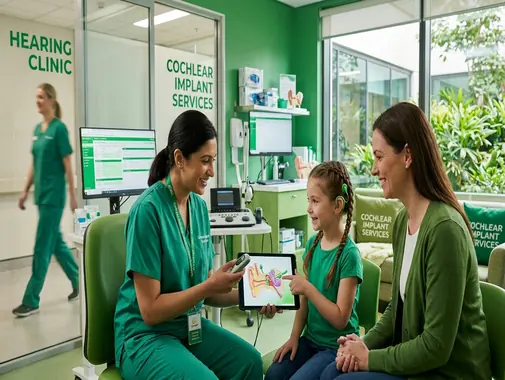
Comprehensive Hearing Assessment, Cochlear Implant Surgery & Auditory Rehabilitation
The Cochlear Implant Service at AS Medical Complex is designed to provide comprehensive evaluation and coordinated care for selected children and adults with severe hearing loss who receive limited benefit from conventional hearing aids and may be suitable candidates for cochlear implantation.
A cochlear implant is a surgically implanted electronic hearing device.
Unlike a conventional hearing aid, which makes sound louder, a cochlear implant bypasses damaged portions of the inner ear and directly stimulates the auditory nerve.
The brain then learns to interpret these electrical signals as sound.
A cochlear implant does not restore normal natural hearing. Instead, it can provide access to useful sound and may help appropriately selected patients improve their ability to:
-
Detect environmental sounds
-
Recognize speech
-
Understand spoken communication
-
Develop speech and language
-
Communicate more effectively
-
Participate in education, work and social activities
Results differ substantially between individuals.
NIDCD emphasizes that cochlear implantation requires both surgery and significant rehabilitation, and that not every person achieves the same level of hearing or speech understanding after implantation.
Cochlear implant care therefore requires a multidisciplinary pathway involving:
-
ENT / Otolaryngology
-
Audiology
-
Cochlear implant surgery
-
Speech and Language Pathology
-
Pediatrics where appropriate
-
Radiology
-
Anesthesia
-
Psychology or developmental assessment where indicated
-
Rehabilitation
-
Long-term device programming and follow-up
rather than surgery alone.
Our Cochlear Implant Services
Depending on confirmed specialist, surgical, audiology and rehabilitation capabilities, Cochlear Implant services at AS Medical Complex may include:
-
Cochlear implant consultation
-
ENT assessment
-
Comprehensive hearing assessment
-
Pure-tone audiometry where age appropriate
-
Speech audiometry
-
Hearing-aid benefit assessment
-
Pediatric hearing evaluation
-
Objective hearing tests where clinically indicated
-
Cochlear implant candidacy assessment
-
Review of previous hearing-aid use
-
Speech and language assessment
-
Developmental assessment in selected children
-
Preoperative medical assessment
-
Imaging of the inner ear and temporal bone where required
-
CT assessment where clinically indicated
-
MRI assessment where clinically indicated
-
Anesthesia assessment
-
Cochlear implant surgery where the complete program is available
-
Unilateral cochlear implantation
-
Bilateral cochlear implant evaluation where clinically appropriate
-
Postoperative wound review
-
Initial device activation
-
Cochlear implant programming / mapping where available
-
Hearing and listening rehabilitation
-
Speech and language therapy
-
Pediatric auditory-verbal support where available
-
Adult auditory rehabilitation
-
Long-term implant monitoring
-
Device troubleshooting and referral where appropriate
-
Coordination with educational and developmental services
-
Referral to a specialist cochlear implant centre where required
Cochlear implant surgery should only be promoted as an onsite AS Medical Complex service once the complete ENT surgical, audiological, device-programming, anesthesia, postoperative and rehabilitation pathway has been confirmed.
What Is a Cochlear Implant & How Does It Work?
A cochlear implant typically has an external component and an internal implanted component.
The external system usually includes:
-
Microphone
-
Sound/speech processor
-
Transmitting component
The surgically implanted system includes:
-
Receiver/stimulator
-
Electrode array placed within the cochlea
The microphone captures sound from the environment.
The processor converts that sound into coded information.
Signals are transmitted to the implanted receiver, which sends electrical impulses through the electrode array.
These electrical impulses stimulate different regions of the auditory nerve.
The auditory nerve then sends the information to the brain, where it is interpreted as sound.
Cochlear Implant vs Hearing Aid
A hearing aid and a cochlear implant work in fundamentally different ways.
Hearing Aid
A hearing aid:
-
Detects sound
-
Amplifies sound
-
Delivers louder acoustic sound through the normal hearing pathway
It relies on the remaining function of the ear to process that sound.
Cochlear Implant
A cochlear implant:
-
Converts sound into electrical signals
-
Bypasses damaged portions of the inner ear
-
Directly stimulates the auditory nerve
FDA describes cochlear implants as devices intended for appropriately selected people with severe-to-profound hearing loss who receive little or insufficient benefit from conventional hearing aids.
A cochlear implant should therefore not automatically be recommended simply because a patient has hearing loss.
A complete hearing assessment is required first.
Who May Benefit From a Cochlear Implant?
Cochlear implants can be considered for selected children and adults with significant sensorineural hearing loss.
Potential candidates may include people who:
-
Have severe or profound sensorineural hearing loss
-
Receive limited benefit from appropriately fitted hearing aids
-
Have difficulty understanding speech despite hearing-aid use
-
Have significant bilateral hearing impairment
-
Have progressive hearing loss
-
Lost hearing after previously developing spoken language
-
Were born with significant hearing loss
-
Have other hearing patterns falling within the indications of an appropriate implant system
Candidacy should not be decided from the pure-tone hearing test alone.
Evaluation may also consider:
-
Speech understanding
-
Hearing-aid benefit
-
Duration of hearing loss
-
Age at onset
-
Auditory nerve and cochlear anatomy
-
Communication development
-
Previous rehabilitation
-
Medical fitness for surgery
-
Patient and family expectations
-
Commitment to rehabilitation
NIDCD notes that both children and adults with severe hearing impairment can benefit from cochlear implantation, but performance after implantation varies and requires rehabilitation and active patient participation.
Cochlear Implants in Adults
Adults may be referred for cochlear implant assessment when hearing aids no longer provide adequate speech understanding.
This can include patients who:
-
Developed hearing normally and later lost hearing
-
Have progressively worsening hearing
-
Struggle to understand speech even with properly fitted hearing aids
-
Depend heavily on lip-reading
-
Have difficulty communicating at home, work or socially
Adults who previously heard spoken language may learn to associate implant signals with sounds they remember.
However, outcomes vary according to factors such as:
-
Duration of severe hearing loss
-
Previous hearing experience
-
Auditory nerve function
-
Rehabilitation participation
-
Other medical conditions
No test can guarantee beforehand exactly how well an individual will understand speech after implantation.
Cochlear Implants in Children
For a child with significant hearing loss, access to sound can be particularly important during the years when the brain is rapidly developing speech and language pathways.
Children may be considered for cochlear implantation after an appropriate pediatric hearing assessment demonstrates that conventional amplification is not providing adequate access to sound.
Evaluation may consider:
-
Degree and type of hearing loss
-
Hearing-aid use
-
Auditory responses
-
Speech and language development
-
Communication skills
-
Developmental history
-
Inner-ear anatomy
-
Family expectations
-
Ability to participate in rehabilitation
NIDCD reports that appropriately selected children who receive implants at younger ages can gain access to sound during an important period for speech and language development.
However, age alone does not determine candidacy.
The exact age, hearing criteria and other requirements can depend on:
-
The implant system
-
Regulatory indications
-
The child's medical condition
-
Specialist recommendations
Cochlear Implant Candidacy Assessment
A cochlear implant evaluation is a detailed process rather than a single hearing test.
The goal is to answer several questions:
-
How severe is the hearing loss?
-
What type of hearing loss is present?
-
Are appropriately fitted hearing aids providing useful benefit?
-
Is the auditory nerve likely to be able to receive implant stimulation?
-
Is the cochlea anatomically suitable?
-
Is surgery medically appropriate?
-
What communication outcomes can realistically be expected?
-
Can the patient and family participate in rehabilitation?
Audiological Assessment
Hearing assessment may include:
-
Pure-tone audiometry
-
Speech audiometry
-
Speech-recognition testing
-
Tympanometry
-
Otoacoustic emissions where appropriate
-
Auditory Brainstem Response testing where required
-
Hearing-aid verification
-
Aided hearing testing
-
Other age-appropriate audiological investigations
For young children who cannot reliably complete behavioral hearing tests, objective testing may be particularly important.
Hearing-Aid Assessment
Before cochlear implantation, the clinical team generally needs to determine whether appropriately selected and fitted hearing aids provide sufficient benefit.
A hearing aid should not be declared ineffective simply because:
-
It was uncomfortable
-
It was poorly fitted
-
It was not programmed appropriately
-
It was used inconsistently
The audiology team may review:
-
Hearing-aid type
-
Fitting
-
Programming
-
Daily use
-
Aided speech understanding
-
Functional hearing
Cochlear implant candidacy is considered when conventional amplification remains insufficient for the patient's hearing and communication needs.
Imaging & Medical Assessment Before Surgery
Selected cochlear implant candidates require imaging of the ear and surrounding structures before surgery.
Depending on the clinical question, this may involve:
-
CT Scan
-
MRI
-
Both examinations
Imaging can help assess:
-
Cochlear anatomy
-
Inner-ear malformations
-
Auditory nerve
-
Temporal bone anatomy
-
Previous infection or surgery
-
Other anatomical factors relevant to implantation
The appropriate imaging examination should be selected by the ENT and Radiology teams.
Medical assessment may also include:
-
General physical examination
-
Medical history
-
Medication review
-
Previous ear infections
-
Previous ear surgery
-
Vaccination status
-
Anesthesia assessment
-
Laboratory testing where indicated
Children may additionally require coordination with:
-
Pediatrics
-
Developmental specialists
-
Speech and Language Pathology
according to their needs.
Cochlear Implant Surgery
Cochlear implantation is usually performed under general anesthesia.
During surgery, the surgeon creates access behind the ear and places the internal receiver beneath the skin.
An electrode array is carefully inserted into the cochlea.
The surgical team may perform appropriate intraoperative checks according to the implant system and hospital protocol.
After surgery, the external sound processor is generally not immediately used as normal hearing begins only after the surgical site has had time to heal and the implant is activated and programmed.
The patient then returns for device activation according to the implant programme.
Cochlear implant surgery is only one stage of the treatment pathway.
NIDCD emphasizes that the patient must subsequently learn or relearn how to interpret the electrical sound signals generated by the implant.
One Ear or Both Ears?
Some patients may receive:
-
One cochlear implant
-
Cochlear implants in both ears
-
A cochlear implant in one ear and a hearing aid in the other
The appropriate approach depends on:
-
Hearing levels in each ear
-
Hearing-aid benefit
-
Speech understanding
-
Age
-
Anatomy
-
Clinical indications
-
Patient needs
-
Implant eligibility
Bilateral hearing input can offer benefits in selected patients, but bilateral implantation is not automatically required for every candidate.
The cochlear implant team should determine the appropriate strategy individually.
Activation, Programming & Cochlear Implant Mapping
The implanted device does not provide its full functional benefit simply because surgery has been completed.
After appropriate postoperative healing, the external processor is fitted and the implant is activated.
An audiologist then programs the device.
This process is commonly called:
-
Mapping
-
Programming
-
Cochlear implant fitting
During mapping, the audiologist adjusts electrical stimulation levels to create an individualized programme for the patient's auditory system.
Initial sound may seem:
-
Unfamiliar
-
Mechanical
-
Artificial
-
Different from remembered hearing
FDA notes that people who previously had hearing sometimes initially describe cochlear implant sound as mechanical or synthetic, although perception may change as the brain adapts.
Programming usually requires repeated visits.
Adjustments may be needed as:
-
The patient adapts
-
Hearing responses change
-
Speech understanding develops
-
The child's ability to respond improves
-
Clinical needs change
Long-term audiology follow-up is therefore an essential component of cochlear implant care.
Hearing, Speech & Auditory Rehabilitation
A cochlear implant provides access to sound, but the brain must learn how to use the information.
This makes rehabilitation extremely important.
Depending on age and hearing history, rehabilitation may focus on:
-
Sound awareness
-
Sound discrimination
-
Identifying environmental sounds
-
Speech recognition
-
Listening skills
-
Spoken language development
-
Pronunciation
-
Communication strategies
-
Listening in background noise
-
Telephone communication
-
School or workplace listening
NIDCD states that audiologists and Speech-Language Pathologists are frequently involved in helping patients learn to interpret sound after cochlear implantation.
FDA similarly emphasizes that active participation in auditory training is an important factor in successful cochlear implant use.
Speech & Language Therapy for Children
Children who receive cochlear implants may require structured and long-term support for:
-
Listening
-
Speech
-
Language
-
Communication
-
Classroom participation
Therapy should be individualized according to the child's:
-
Age
-
Previous hearing experience
-
Communication development
-
Developmental profile
-
Educational environment
-
Progress after activation
Parents and caregivers are important members of the rehabilitation team because children learn language throughout everyday activities—not only during therapy sessions.
Family involvement can include:
-
Talking frequently with the child
-
Encouraging listening
-
Reading
-
Naming everyday objects
-
Responding to communication attempts
-
Practising therapy strategies at home
FDA notes that cooperation between the child, family, teachers and healthcare professionals can influence rehabilitation after cochlear implantation.
Expected Benefits & Important Limitations
Possible benefits of cochlear implantation can include improved ability to:
-
Detect sounds
-
Recognize environmental warning sounds
-
Understand speech
-
Communicate verbally
-
Follow conversations
-
Use telephones in selected cases
-
Participate more independently in daily activities
However, cochlear implants do not produce identical results in every patient.
FDA specifically notes that recipients:
-
May hear sound differently from normal hearing
-
May not understand language as well as other successful recipients
-
May lose residual hearing in the implanted ear
-
May experience device failure
-
May require additional surgery
-
Cannot be guaranteed a specific level of speech understanding
Outcome can be influenced by:
-
Age
-
Cause of hearing loss
-
Duration of severe hearing impairment
-
Previous hearing experience
-
Auditory nerve function
-
Consistency of device use
-
Quality of programming
-
Rehabilitation
-
Additional developmental or neurological conditions
Families should therefore receive realistic counselling before surgery.
A cochlear implant should never be presented as a guarantee that a child will develop completely normal speech or that an adult will regain normal natural hearing.
Surgical Risks, Meningitis & Medical Safety
Cochlear implantation is generally established surgery, but it carries risks like any operation.
Potential complications may include:
-
Wound infection
-
Bleeding or fluid collection
-
Dizziness or vertigo
-
Tinnitus
-
Taste disturbance
-
Numbness around the ear
-
Loss of remaining hearing
-
Cerebrospinal-fluid leak
-
Inner-ear fluid leak
-
Device problems
-
Need for revision surgery
-
Other uncommon complications
FDA also identifies bacterial meningitis as a rare but serious potential complication associated with cochlear implants.
Vaccination Before Cochlear Implantation
People who have or are candidates for cochlear implants have an increased risk of certain forms of bacterial meningitis, particularly pneumococcal meningitis.
CDC therefore recommends appropriate pneumococcal vaccination for cochlear implant recipients and candidates according to age and vaccination history.
CDC also recommends that people preparing for cochlear implant surgery receive recommended pneumococcal vaccine doses sufficiently before surgery when possible; specific vaccine requirements depend on age and previous vaccination history.
Vaccination planning at AS Medical Complex should follow:
-
Current applicable vaccination recommendations
-
Patient age
-
Previous vaccine history
-
Pediatric or adult medical assessment
-
Local clinical policy
Patients should not independently choose additional vaccines without appropriate medical review.
Cochlear Implants, MRI & Everyday Device Safety
A cochlear implant remains inside the body long-term and can affect certain future medical investigations and procedures.
One particularly important consideration is MRI.
Many cochlear implants contain magnets.
MRI scanners use strong magnetic fields, which can potentially interact with the implanted magnet.
FDA states that cochlear implants may be:
-
MR Unsafe
-
MR Conditional
depending on the exact implant model.
Some implants can undergo MRI only under specific conditions, while others may require additional precautions or magnet management.
Patients should therefore:
-
Know the brand and model of their cochlear implant.
-
Keep their implant identification card.
-
Tell every doctor and MRI technologist that they have a cochlear implant.
-
Never assume an MRI is automatically safe.
-
Follow the implant manufacturer's MRI instructions.
FDA specifically recommends carrying the implant card and checking device-specific MRI conditions before scanning.
Protecting the External Processor
The external sound processor also requires appropriate care.
Depending on the specific device, patients may need to take precautions involving:
-
Water
-
Impact
-
Static electricity
-
Strong magnetic environments
-
Certain medical treatments
-
Contact sports
Device-specific guidance should always come from:
-
Implant manufacturer
-
Cochlear implant audiologist
-
Implant centre
rather than assuming all devices have identical restrictions.
Follow-Up & Long-Term Cochlear Implant Care
Cochlear implantation requires lifelong follow-up.
After surgery and activation, ongoing care may include:
-
Wound review
-
Audiology appointments
-
Implant mapping
-
Hearing tests
-
Speech-perception testing
-
Speech and language assessment
-
Rehabilitation
-
Device troubleshooting
-
Processor maintenance
-
Educational support
-
Monitoring of ear health
-
Assessment of changing hearing needs
Children may require particularly close developmental monitoring because hearing influences:
-
Speech
-
Language
-
Education
-
Social development
Adult recipients may continue to require auditory rehabilitation as they learn to understand speech through the implant.
Patients should also keep information about:
-
Implant manufacturer
-
Implant model
-
Surgery date
-
Implant side
-
External processor
-
MRI conditions
available throughout life.
When Should You Consider Cochlear Implant Assessment?
A child or adult may benefit from cochlear implant evaluation when there is:
-
Severe or profound sensorineural hearing loss
-
Limited benefit from appropriately fitted hearing aids
-
Poor speech understanding despite amplification
-
Significant difficulty communicating because of hearing loss
-
Progressive severe hearing loss
-
Congenital significant hearing loss
-
Specialist recommendation for cochlear implant candidacy assessment
Parents should also seek specialist hearing evaluation when a child:
-
Does not respond consistently to sounds
-
Does not respond to name as expected
-
Has significant speech and language delay
-
Has failed newborn or childhood hearing screening
-
Appears dependent on visual cues to understand communication
Not every child with speech delay has hearing loss, and not every person with hearing loss requires a cochlear implant.
The first step is appropriate ENT and audiological assessment.
When Is Urgent Medical Care Required?
Most cochlear implant assessment and follow-up occurs through planned outpatient care.
However, urgent medical review may be required after surgery if the patient develops:
-
High fever
-
Severe headache
-
Stiff neck
-
Persistent vomiting
-
Significant confusion
-
Severe wound redness or swelling
-
Pus or fluid drainage from the surgical site
-
Severe increasing pain
-
Facial weakness
-
Significant dizziness with deterioration
-
Sudden neurological symptoms
-
Other serious postoperative illness
Because bacterial meningitis is a recognized risk in cochlear implant recipients, symptoms concerning for meningitis require urgent medical assessment rather than waiting for a routine ENT appointment.
Likewise, significant trauma directly over the implanted device should be medically assessed if associated with:
-
Pain
-
Swelling
-
Sudden loss of implant function
-
Neurological symptoms
-
Other concerning changes
Multidisciplinary Cochlear Implant Care
Successful cochlear implantation depends on coordinated care across several specialties.
Depending on the patient, the care pathway at AS Medical Complex may involve:
-
ENT / Otolaryngology
-
Cochlear Implant Surgery
-
Audiology
-
Speech and Language Pathology
-
Pediatrics
-
Child Development Assessment
-
Neurology where appropriate
-
Radiology
-
Anesthesia
-
Psychology
-
Rehabilitation
-
Vaccination services
-
Other specialists
For children, coordination with:
-
Parents
-
Teachers
-
Schools
-
Therapists
can also be important.
The aim is not simply to implant a device.
The aim is to provide the patient with the best achievable opportunity to access sound, develop or improve listening skills, communicate effectively and participate in everyday life.
Long-term progress should therefore be assessed through hearing, communication and functional outcomes—not simply whether the implant is switched on.
Cochlear Implant FAQs
What is a cochlear implant?
A cochlear implant is an electronic hearing device with an external sound processor and an internal surgically implanted component. Unlike a hearing aid, which makes sound louder, a cochlear implant bypasses damaged portions of the inner ear and directly stimulates the auditory nerve. It does not restore normal hearing but can provide useful access to sound for appropriately selected patients.
Who may be suitable for a cochlear implant?
Selected children and adults with significant sensorineural hearing loss who receive limited benefit from appropriately fitted hearing aids may be considered for cochlear implantation. Candidacy depends on hearing tests, speech understanding, hearing-aid benefit, medical and anatomical assessment, communication needs and other individual factors. A full cochlear implant evaluation is required rather than deciding from one hearing-test result.
Is a cochlear implant better than a hearing aid?
They are designed for different situations. Hearing aids amplify acoustic sound and may work very well when enough useful hearing remains. Cochlear implants bypass damaged inner-ear structures and directly stimulate the auditory nerve, making them appropriate for selected people who do not receive sufficient benefit from conventional hearing aids. A patient should undergo audiological assessment before cochlear implantation is considered.
Will a cochlear implant give me normal hearing?
No. A cochlear implant does not recreate normal natural hearing. The electrical sound may initially seem unfamiliar, and the brain needs time and training to interpret it. Some patients achieve excellent speech understanding while others receive more limited benefit, and no preoperative test can guarantee an individual's final result.
Does a child need speech therapy after a cochlear implant?
Many children require ongoing hearing, speech and language rehabilitation after implantation. The implant provides access to sound, but the child must learn how to recognize, understand and use that sound for communication. Audiologists and Speech-Language Pathologists commonly play important roles in this process, with active involvement from parents and caregivers.
Can a person with a cochlear implant have an MRI?
Sometimes, but MRI safety depends on the exact implant model. Some cochlear implants are MR Conditional and can be scanned only under specified conditions, while others may have different restrictions. Patients should always carry their implant identification information and tell the MRI team about the cochlear implant before entering the MRI environment.
What are the main risks of cochlear implant surgery?
Possible risks include infection, bleeding, dizziness, tinnitus, taste disturbance, loss of residual hearing, fluid leak, device failure, need for revision surgery and uncommon serious complications such as bacterial meningitis. People who have or are candidates for cochlear implants should also have their pneumococcal vaccination status reviewed according to current recommendations.
Cochlear Implant Services at AS Medical Complex
The Cochlear Implant Service at AS Medical Complex is designed to support children and adults with significant hearing loss through a complete pathway of hearing assessment, candidacy evaluation, surgical planning, implantation where available, device activation, programming and long-term auditory rehabilitation.
Cochlear implantation should not be viewed as a standalone operation.
Successful treatment depends on:
-
Accurate diagnosis of hearing loss
-
Appropriate hearing-aid assessment
-
Careful candidate selection
-
Appropriate inner-ear and auditory-nerve anatomy
-
Safe surgery
-
Device activation and programming
-
Consistent implant use
-
Hearing rehabilitation
-
Speech and language support
-
Long-term follow-up
A cochlear implant does not restore normal hearing, and outcomes cannot be guaranteed. However, appropriately selected recipients may gain meaningful access to environmental sounds and speech, and young eligible children may gain important access to sound during critical years of speech and language development.
Care may be coordinated between ENT, Audiology, Speech and Language Pathology, Pediatrics, Child Development Assessment, Radiology, Anesthesia, Psychology, Rehabilitation and other relevant specialties according to the patient's age and individual needs.
Because cochlear implants are lifelong medical devices, recipients also require ongoing consideration of device programming, rehabilitation, vaccination, MRI safety and future medical procedures.
Contact AS Medical Complex for Cochlear Implant assessment if you or your child has severe hearing loss, receives limited benefit from hearing aids, has significant difficulty understanding speech, or has been advised to undergo cochlear implant evaluation. A complete ENT and audiological assessment is required to determine whether cochlear implantation is medically and functionally appropriate.